Marek Partys: A Few Of My Favourite Things
Written by Jamie Madge In Shots
By Chiara Pizzimenti for Vanity Fair
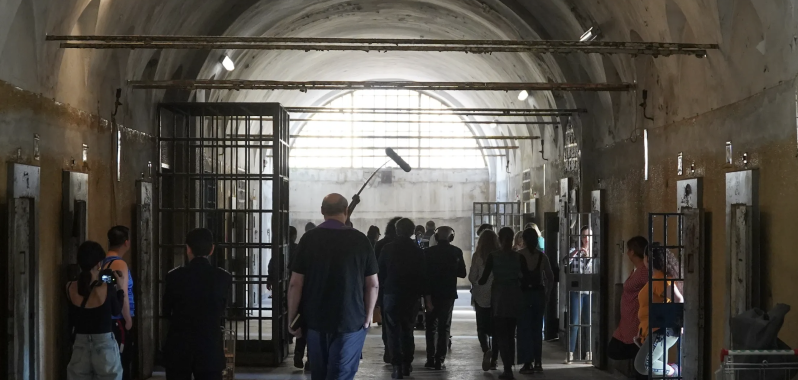
I started photographing backstage of the inmates preparing for theater performances. I wanted to take posed shots, and I convinced the warden to let me shoot in their cells. I told the story of their transformation through art, through colored lights. I transformed San Vittore into a set for three days, and this was my first approach. These photos became an exhibition, and I also decided, thanks to Ferdinando Scianna's advice, to give back, to teach the girls how to photograph. This is just the first part of the answer Cinzia Pedrizzetti gave us at Garda Cinema, the festival where she presented her short film, Caffè Nero Bollente, when asked about when she entered prison.
This is only the first part because the director and photographer doesn't want to leave out even a single step along a journey she clearly loved. She herself uses the word "love."
The inmates who helped me set up the exhibition started telling me that the girls in the photos were their girlfriends. I asked how this kind of relationship could exist, and they told me a little about how, despite not having physical contact, they manage to communicate, fall in love, and form relationships. The film is like this: a mix of stories. The protagonist, Giovanna, is a mix of stories told to me by the inmate girls, first those I photographed and then those I interviewed for the casting and the short film. I asked Massimo Gaudioso, a screenwriter who has worked extensively with Matteo Garrone, for advice.
The film stars Lella Costa and Fiorella Mannoia, who was first approached for the title song of the short, and then appears in the feature with a cameo. The protagonists, however, are the people inside San Vittore prison. "What struck me most was the humanity. I felt close to these people who have little contact with the outside world, who had a great desire to communicate, to exchange. What we noticed with Luca Bigazzi, who was the director of photography, is the sociality that remains. Cell phones don't exist, there's still contact, there are people talking, playing cards, smoking cigarettes, arguing, but it's alive. A community is created."
One might object that, beyond the relationships that are formed, those inside don't want to stay inside, obviously. There were 40 crew members, including some who had never been in a prison before, in a clearly challenging situation, in an abandoned wing, without bathrooms, accompanied by guards, with inmates with long-term sentences. After a few days, a wonderful atmosphere developed between the crew, the prison police, and the inmates. The prison director thanked me for not using San Vittore simply as a backdrop, a stage set. This work gave me the joy of seeing the inmates moved, but also the prison police representatives. Everyone felt part of something and didn't want it to end, because it truly is an encounter, another world, but also an encounter with oneself.
The director and crew were unaware of the inmates' sentences and crimes. "When I wrote this story, I interviewed women. I wondered if there was too much violence in my screenplay, and I realized that what I portrayed in terms of violence is nothing compared to how some of the inmates grew up."
Lead actress Adele Dezi describes a very spontaneous, calm interaction, without distinctions or filters. "With the girls, it was absurd to go out on the second and third day and be asked, 'So, are you getting out?' The idea of working in prison intrigued me because I had had a brief encounter with prison for a loved one. It's a world that keeps you very distant, an environment you hardly know. I never asked questions, but you start to wonder about their story, and their humanity emerges. They become friends and you reason more about the reason for the guilt rather than the guilt itself. You start to dwell on the condition that led to this situation rather than the conviction."
Her story reaches the girls, the spiral that led them there. "In prison, paradoxically, you distance yourself from violence because there's no physicality; you return to a more personal dimension of the soul. What has this job taught me? I think it's important to keep in mind certain environments you might find yourself in due to circumstances that aren't necessarily logical, that don't necessarily follow the rules of human beings, that are imposed from the outside."
Written by Jamie Madge In Shots
Published in Clickz
Published in Shots
Published in LBB
Written in LBB
For LBB